
Where 999 happy haunts meet the high seas in the Haunted. Inside Disney’s most immersive bar ever built.
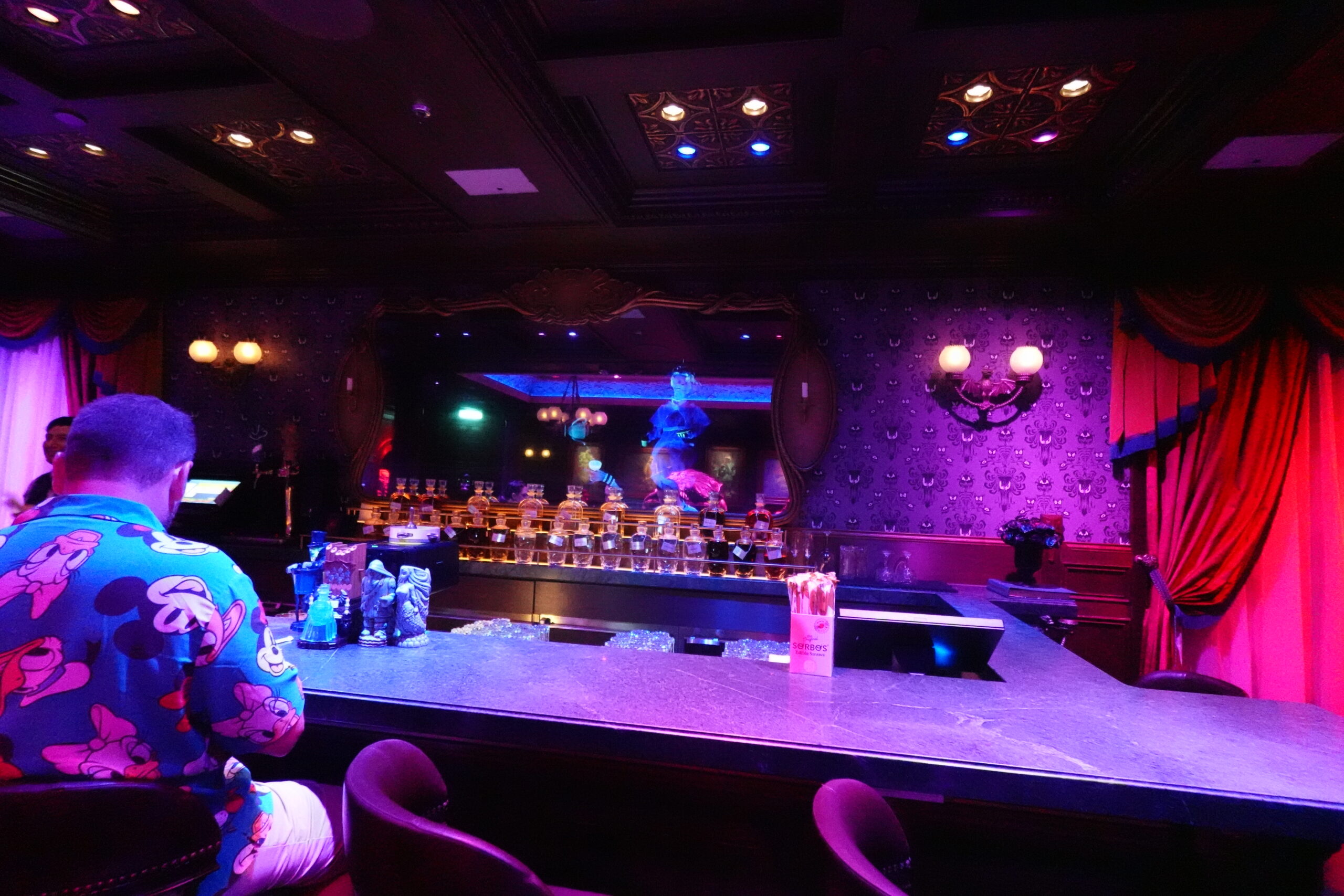
There’s a moment, just after the lights dim and the familiar baritone of the Ghost Host fills the room, when the Haunted Mansion Parlor aboard the Disney Treasure stops being a clever themed cocktail bar and becomes something else entirely. It becomes a place where you genuinely forget you’re on a cruise ship in the middle of the Caribbean. It becomes the reason you booked this sailing in the first place. And if you’re the kind of person who has ridden the Haunted Mansion at Disneyland or Walt Disney World more times than you can count, it becomes something close to a religious experience.
The Haunted Mansion Parlor occupies the same footprint that the Star Wars Hyperspace Lounge held on the Disney Wish, Disney Cruise Line’s previous ship. That earlier space was widely considered a disappointment, a venue that seemed to pour its entire budget into a single impressive screen while leaving the rest of the room feeling hollow and lifeless. With that recent history as context, many fans (myself included) approached the Parlor with cautious optimism. Could Disney Cruise Line and Walt Disney Imagineering actually deliver on such a beloved intellectual property, especially in a relatively compact space?
The answer, resoundingly, is yes.
A Ghost Story Six Decades in the Making
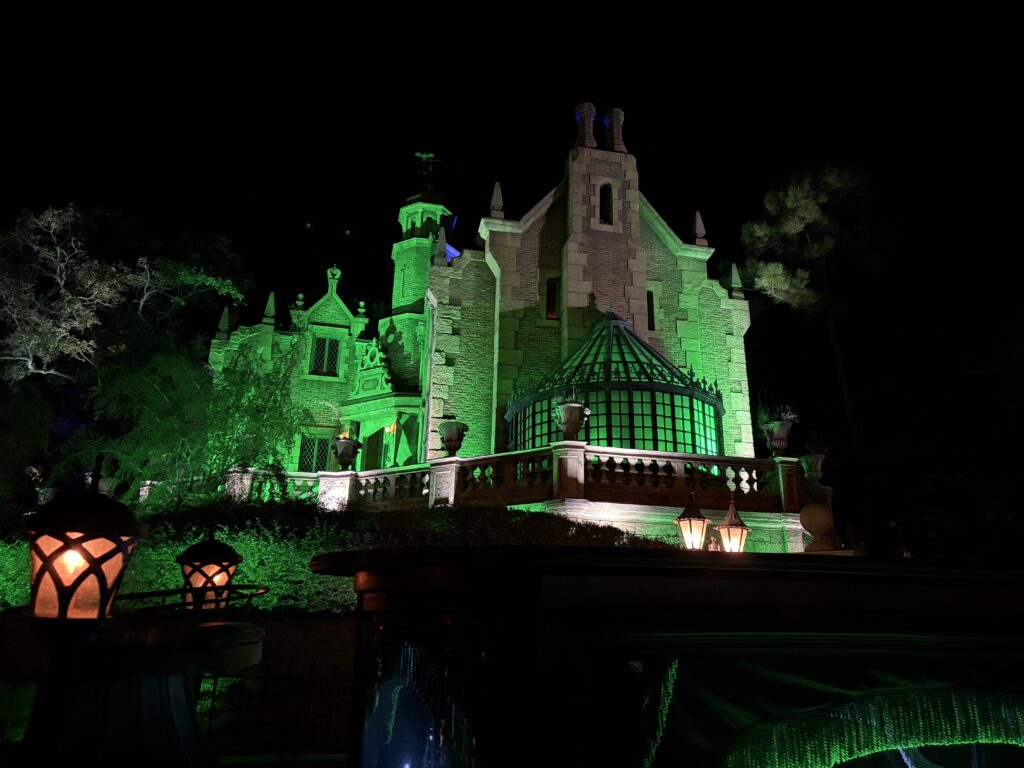
To understand why the Haunted Mansion Parlor resonates so deeply, it helps to know a little about the ride that inspired it. The idea of a haunted attraction at a Disney park is nearly as old as the parks themselves. Walt Disney first envisioned a spooky old house on a hill during the earliest planning stages of Disneyland in the 1950s, with conceptual sketches depicting a decrepit manor overlooking Main Street. But Walt’s famous insistence on keeping his park clean and pristine clashed with the idea of a run-down building. He reportedly insisted that the exterior would remain immaculate and let the ghosts handle the interior.
Imagineer Ken Anderson was tapped to develop a storyline, and what followed was years of creative evolution. Anderson explored walk-through concepts and spooky narratives, but the project kept getting delayed: first by Walt’s commitment to the 1964 World’s Fair, and then by his death in December 1966. The loss left a creative vacuum, and the Imagineers debated the ride’s fundamental tone. Marc Davis, the animator responsible for much of the Jungle Cruise’s humor, pushed for something playful and funny. Claude Coats, a background artist and designer, argued for genuine chills. The finished attraction, which finally opened at Disneyland on August 9, 1969, became the perfect marriage of both sensibilities, whimsical and eerie in equal measure.
Meanwhile, Imagineer Rolly Crump had developed a wild array of concepts for what he called the Museum of the Weird: coffin-shaped clocks, candle-men, talking chairs, man-eating plants, and living gypsy wagons. Walt loved the ideas and envisioned them as a restaurant or walkthrough annex to the main ride, but the Museum of the Weird was shelved when the project shifted to a ride-through format. Those shelved concepts, however, never truly died. They’ve haunted the edges of Disney lore for decades, inspiring comic books, merchandise, and (now) key design elements of the Haunted Mansion Parlor.
The Parlor doesn’t just reference the ride. It resurrects decades of unrealized Imagineering ambition and gives those orphaned ideas a permanent home at sea.
Stepping Through the Portal
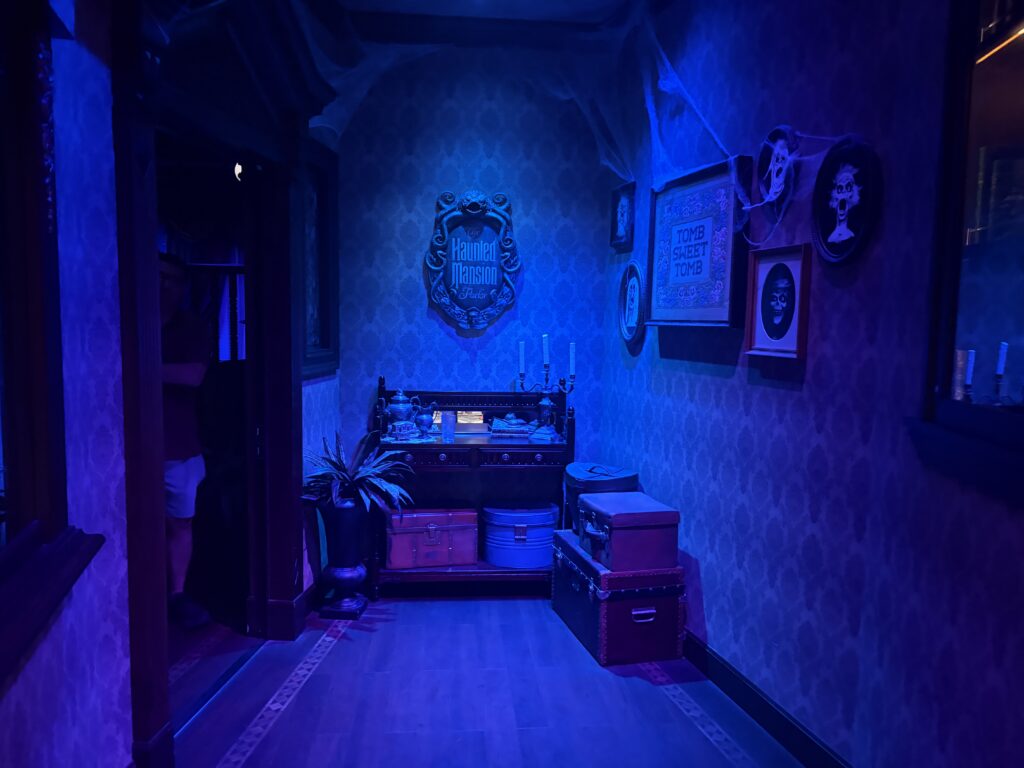
The entrance to the Haunted Mansion Parlor immediately sets a tone of Victorian foreboding. You’re not walking into a standard cruise ship lounge. You’re crossing a threshold. The design language draws from the antebellum Southern gothic architecture of the Walt Disney World version and the moody New Orleans atmosphere of the Disneyland original, blending them into something that feels both familiar and entirely new.
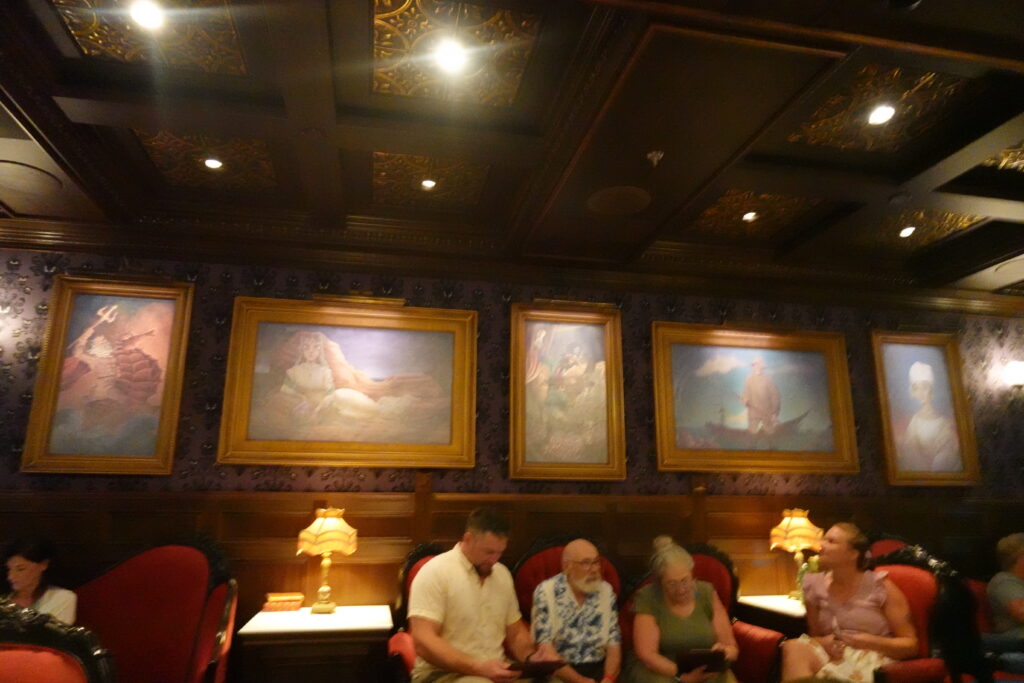
At the start of the experience, the room appears as a dimly lit but dignified Victorian parlor. The lighting is warmer than you might expect, the furniture plush and period-appropriate. Portraits line the walls in gilded frames. Everything looks stately, perhaps a touch unsettling, but not yet possessed. This mirrors the opening act of the ride itself, where guests are lulled into a false sense of normalcy before the supernatural takes over.
And then the Ghost Host speaks.
His voice fills the room, and the Parlor transforms. The portraits begin to change. Effects ripple across the space, not just on one big screen, but all around you. This is the key difference between the Haunted Mansion Parlor and its predecessor. Rather than funneling your attention toward a single focal point, Imagineering has made the entire room the show. Paintings shift and stretch. Madame Leota is summoned to the magic mirror behind the bar. Familiar characters and scenes from the ride materialize and dissolve. The whole experience operates on a show cycle lasting somewhere between 30 and 40 minutes, following the narrative arc of the attraction. But instead of gliding through in a Doom Buggy, you’re seated in a wingback chair with a themed cocktail in hand, surrounded by the story on all sides.
Design in the Details
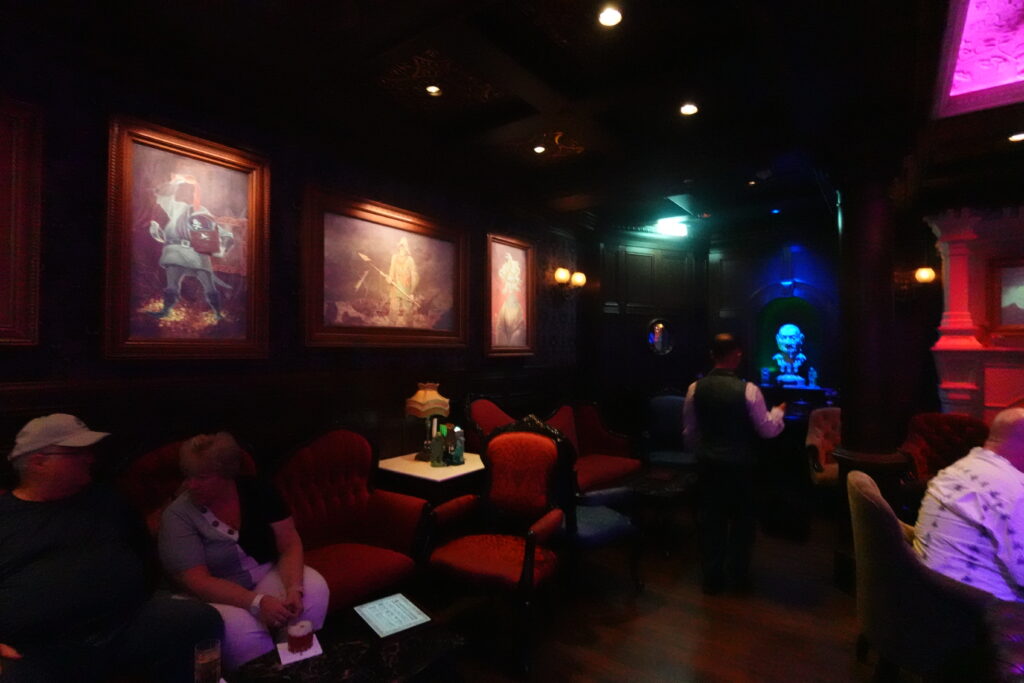
What elevates the Haunted Mansion Parlor from a good themed bar to a potentially great one is the depth of its design work. The space is dense with references, Easter eggs, and Imagineering craft that reward close attention. There are deep-cut nods to the Museum of the Weird concepts that Rolly Crump developed in the 1960s, woven into the decor alongside an original seafaring storyline created specifically for the cruise ship setting. That maritime narrative pulls from obscure corners of Haunted Mansion history and concept art, and it fits the Disney Cruise Line context with a naturalness that feels like it was always meant to be.
The iconic purple wallpaper makes an appearance, of course, but it’s not simply slapped onto the walls as fan service. It’s integrated into a broader interior design scheme that includes Gothic flourishes, Victorian furniture, and spectral lighting effects that shift and evolve throughout the show cycle. Fan-favorite details are present, including nods to beloved ride characters, but they’re layered into the environment rather than displayed like museum exhibits.
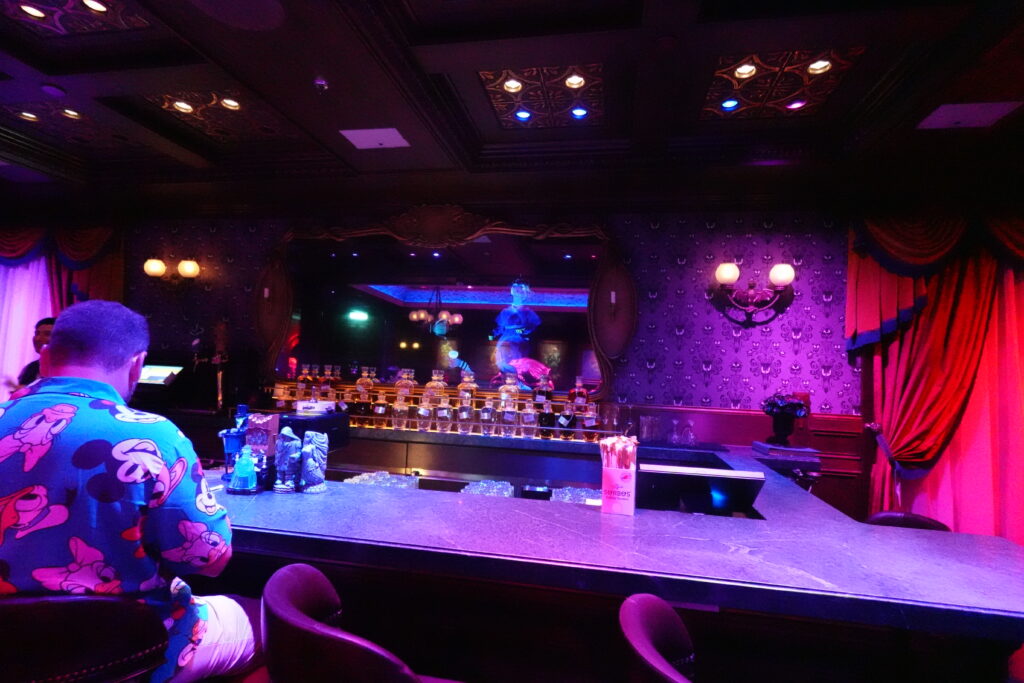
The bar itself, anchored by the magic mirror where Madame Leota holds court, serves as the room’s dramatic centerpiece. But Imagineering has been careful to distribute visual interest throughout the space, so there’s no dead zone where the theming drops off. Every corner holds something worth discovering, and repeat visits reveal gags and references you missed the first time around.
Why It Matters
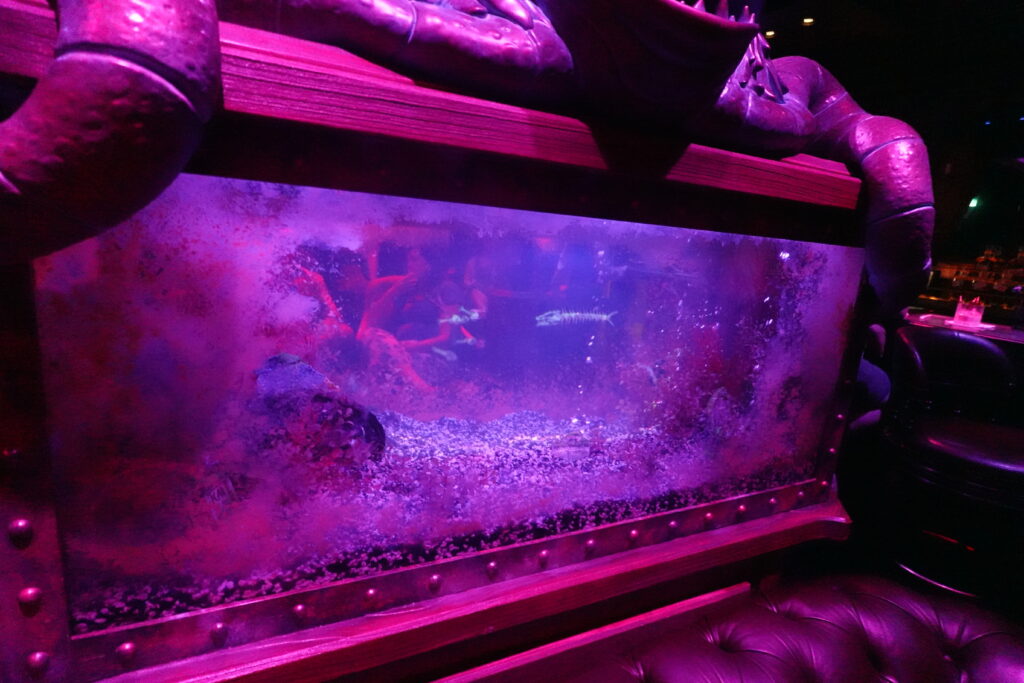
Disney Cruise Line has always had a certain elegance, but its themed environments have historically operated at a different register than the parks. The ships are beautiful, but they tend toward a polished Art Deco sophistication rather than the narrative-driven immersion of a theme park dark ride. The Haunted Mansion Parlor changes that equation. It represents the first time a Disney cruise ship venue has truly matched the thematic density and storytelling ambition of the best Imagineered spaces on land.
In the crowded field of Disney’s themed bars (a category that includes beloved venues like Trader Sam’s, Oga’s Cantina, Jock Lindsey’s Hangar Bar, and the Carthay Circle Lounge) the Haunted Mansion Parlor holds its own and then some. It may, in fact, be the best themed bar Disney has ever built, full stop. That’s a bold claim, but the combination of rich source material, meticulous Imagineering, and genuinely immersive show elements makes a strong case.
For Haunted Mansion devotees, the Parlor is a pilgrimage. For cruise passengers who’ve never given the ride much thought, it’s a revelation. And for anyone who worried that Disney Cruise Line would repeat the mistakes of the Hyperspace Lounge, all sizzle and no soul, the Haunted Mansion Parlor is the most persuasive rebuttal imaginable. The ghosts have followed you to sea, and they’ve never looked better.
If you’re considering purchasing DVC on the resale market, Vacation Club Loans offers flexible financing options with low interest rates and no prepayment penalties. Contact us today or apply now to get started!